Misophonia, an often misunderstood condition involving strong emotional reactions to specific sounds, is an area of both personal and professional expertise for me. I live with misophonia myself, which means the people I work with won't have to spend the first three sessions explaining what it is. I bring that lived experience together with clinical training to help people whose daily functioning is disrupted by sound sensitivities, integrating evidence based CBT strategies tailored to reduce distress and improve quality of life.
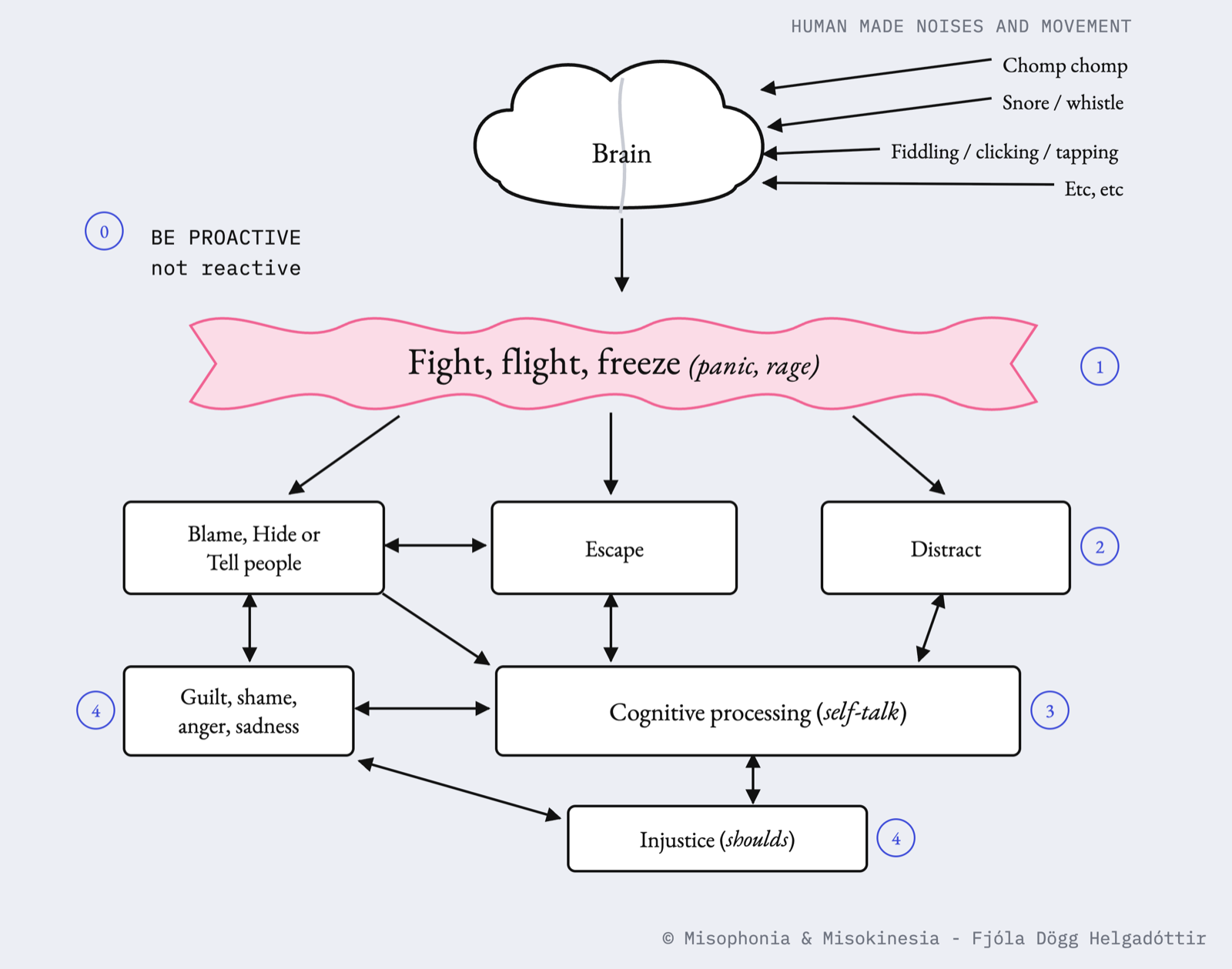
I'm fascinated by the misophonic brain, why a small, ordinary sound can trigger a full fight, flight, or freeze response in one person and go completely unnoticed by another. I'm especially interested in what actually helps in the moment, helpful distractions, including something as simple as music, and in how differently misophonia shows up from person to person. Below is a rough model I use to explain that response: from the trigger sound, through the fight, flight, or freeze reaction, to the different ways people cope, and how some of those coping responses can loop back into guilt and shame.
Misophonia has historically had far less research behind it than better known neurodevelopmental conditions. A recent comparison of Google Scholar results found roughly 1.34 million results for autism and 272,000 for dyslexia, against just 823 for misophonia, a gap that reflects how new and underfunded the field still is. That said, it is changing quickly. There has been a noticeable multiplication of publications from 2017 onwards, and misophonia is gaining recognition as an important area of scientific and clinical interest, a rapidly growing field with new findings emerging at an accelerating pace.
Against that backdrop, misophonia specific CBT protocols pioneered at the University of Oxford represent an exciting new direction in treatment. My own time at Oxford was spent on depression and eating disorder work, not misophonia, but it is the same institution now leading some of the most significant work in this area, alongside Amsterdam UMC, and protocols from both show meaningful clinical improvement for a substantial proportion of people who try them. I want to be precise about what that means: this work is not universally effective, and anyone promising a cure is overstating what we currently know. The realistic goal is reducing the intensity and duration of reactions and loosening the grip of avoidance, not eliminating the reaction altogether.
In practice, that starts with a detailed assessment to map a person's specific triggers, their reactions, and what they have started avoiding because of them. From there, the work draws on attention focused techniques, adjusting a person's relationship to the trigger, and arousal reduction, tracked with brief psychometric measures before every session, so progress is something we can actually see.
Bringing together rigorous clinical science and first hand understanding, the book I'm writing takes shape as a collection of short stories, each one approaching misophonia from a different angle rather than laying out a single clinical account. Some sit in practical territory, like what schools can actually do to support a misophonic child in the classroom. Others sit somewhere harder and more private, like what you do when the person who triggers your misophonia is a child or parent you love more than anything in the world. The aim is to bring that same combination of rigor and lived experience to people who cannot yet access specialist misophonia treatment, and to the clinicians treating them. It is still in progress, being written the same way every AICBT program has been built: grounded in clinical technique, reviewed carefully, and published only once it's ready. I'll share more here as it develops.
If you experience misophonia yourself, or work with people who do, I'd genuinely like to hear what's been missing from the resources available to you so far.